Bitcoin miners are stepping away from a prolonged stretch of financial hardship as surging BTC prices propel daily revenues upward by 78%.
Data from CryptoQuant’s weekly report, provided to CryptoSlate, shows that total daily mining revenue jumped from roughly $27 million during July’s market troughs to as high as $48 million. This surge followed a roughly 45% rebound in Bitcoin’s price, moving from $58,000 to past $83,000.
This market turnaround is likewise reflected in the hashprice, a heavily monitored indicator of mining economics that measures the projected daily earnings of a specific unit of computing power.
According to Hashrate Index metrics, the indicator recently surpassed $40 per petahash per second daily, hitting its highest mark since January, before ticking down slightly to roughly $39 near press time.
This rebound represents a sharp recovery from the financial stress the sector faced earlier in the year. CoinShares previously documented that the hashprice dropped to around $27.70 in June, driven down by lower BTC valuations, consistently weak transaction fees, and mining difficulty that stayed high relative to earnings.
Although this subsequent bounce has bolstered the viability of operating mining hardware, the actual benefits vary widely among firms depending on their electricity expenses, equipment efficiency, and financing commitments.
Bitcoin’s rally reverses months of mining distress
Metrics from CryptoQuant’s Miner Profit/Loss Sustainability gauge highlight that the industry’s financial standing has strengthened considerably since August.
From May through August, miners largely fell into the “extremely underpaid” bracket, signaling that, under the platform’s framework, revenues fell short given the network’s processing difficulty.
That dynamic shifted on August 21 when Bitcoin traded near $76,000. Ever since, the metric has stayed mostly within the “fairly paid” category, indicating that mining income has bounced back in proportion to the computing power needed to safeguard the network.
This shift is vital because mining companies earn payouts denominated in Bitcoin, whereas power bills, machine financing, and other overheads are typically settled in fiat currency.
Consequently, higher Bitcoin valuations boost the fiat value of mining rewards without instantly driving up operational expenditures.
Still, an elevated hash price also points to shifts in network competition, since every unit of computational power yields greater revenue when fewer participants vie for identical block rewards.
Such mechanics clarify why total industry income and individual operational economics have bounced back, even though the broader network hashrate sits below its historic high.
CryptoQuant noted that the network hashrate climbed back to roughly 962 exahashes per second (EH/s), improving from 899 EH/s on July 31 when falling valuations squeezed profit margins.
This upward correction has shrunk the network’s decline from a peak drop of roughly 18% in late July down to 13%, likely because better margins are prompting operators to reactivate idle computing hardware.
Even so, the financial recovery remains heavily tied to market pricing for Bitcoin rather than a boost in transactional activity.
CryptoQuant highlighted that average daily transaction fees on a seven-day window grew from approximately $195,000 to $275,000, which is still well underneath the $400,000 to $800,000 band seen during periods of 2025.
As a result, block subsidies continue to drive the bulk of mining income, leaving businesses vulnerable to renewed stress if Bitcoin values slide or difficulty scales faster than revenue.
Miner selling pressure eases as profitability returns
Better mining economics are likewise starting to shift how operators handle their accumulated Bitcoin assets.
CryptoQuant observed that extreme miner outflows have halted since August 21, a date when roughly 29,000 BTC left wallets linked to miners as the cryptocurrency pushed toward $76,000.
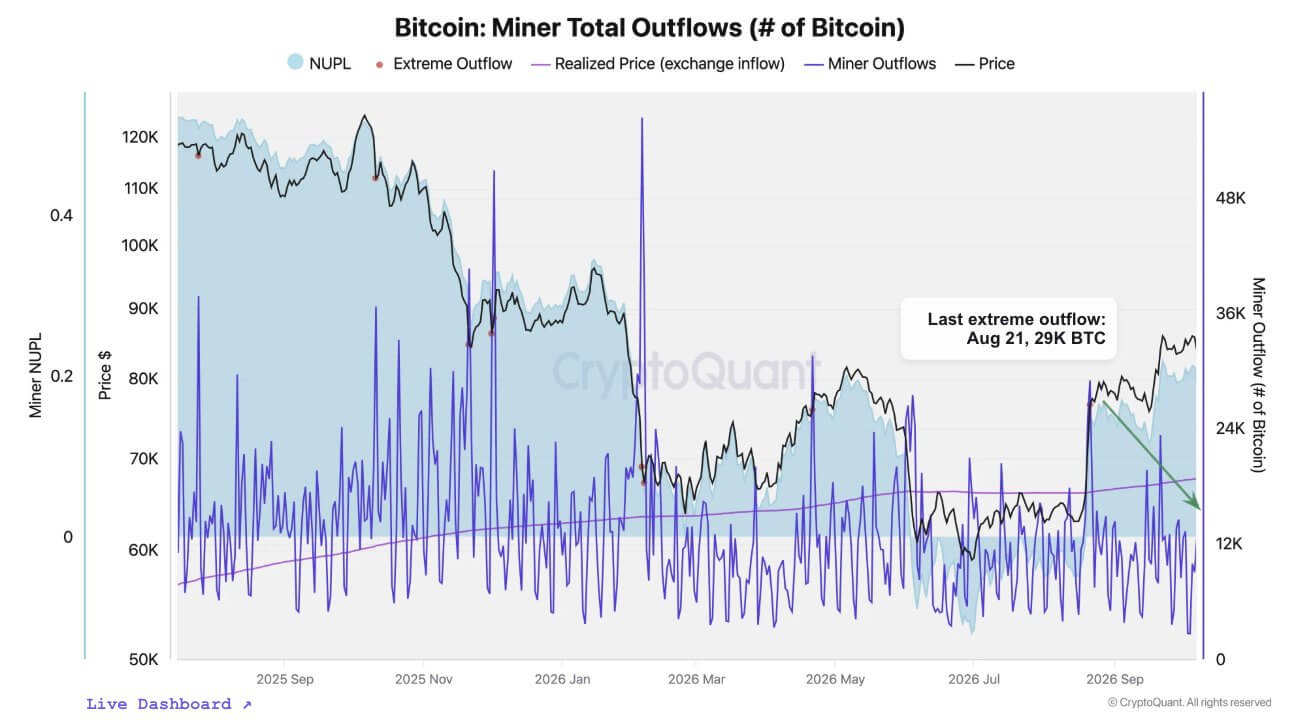
Since that time, transfer amounts have normalized, with daily movements hovering near 12,000 BTC.
Although wallet transfers do not automatically signify immediate spot market liquidations, this drop may signal that miners feel less urgency to offload sizeable amounts of Bitcoin following months of economic strain.
This behavioral shift is also visible among some of the network’s oldest participants.
CryptoQuant data indicates that Satoshi-era participants, leaving out wallets tied to Patoshi, shifted roughly 600 BTC out of their accounts throughout September, marking about a 70% decrease from the near 2,000 BTC moved in January.
Their collective stockpiles remain significant at around 590,000 BTC, meaning shifts in their spending habits remain relevant to the broader market supply outlook.
Simultaneously, entities holding between 100 and 1,000 BTC have halted the reduction of their total balances following months of drawdown.
The total reserves of this group dropped by roughly 20% from 64,000 BTC in December 2025 to approximately 51,000 BTC by early September, after which their balances leveled off.
This stabilization could indicate that miners are depending less on liquidating past stockpiles as their day-to-day conditions improve.
For investors, this reduced liquidation pressure removes a supply hurdle that weighed down valuations throughout the slump. Nonetheless, miners have yet to display a consistent return to accumulation.
Bitcoin’s $80,000 support level emerges as a test for mining profits
At the same time, emerging structural limits may cap how far the sector’s financial turnaround can go.
As operators fire up hardware and network competition grows fiercer, rising difficulty could squeeze hashprices once more unless Bitcoin’s market price continues its upward trajectory.
CryptoQuant pointed to Bitcoin’s 365-day moving average near $80,000 as a crucial short-term support zone, with the 200-day moving average sitting close to $71,000.
A sustained pullback toward those thresholds could test the earnings gains miners secured after July, particularly for firms operating older and less energy-efficient machinery.
A true, lasting recovery will depend on whether major operators start accumulating Bitcoin reserves once again while network hashrates keep climbing—a sign that growing revenues comfortably cover operational costs and encourage fresh saving despite heightened competition.