A cryptocurrency selloff pushed Bitcoin to an intraday low near $80,000, setting off a liquidation bloodbath that exceeded $1 billion and predominantly crushed bullish trader positions.
At the time of publication, the leading cryptocurrency traded around $80,744, marking a 24-hour decline of 3% and a weekly drop of about 4%, which pushes it further away from its recent push to reclaim the $87,000 level.
According to data from CoinGlass, the downturn caused $1.16 billion in liquidations across the derivatives market over the prior 24 hours. Long positions represented $1 billion of that amount, with short positions making up just $108 million.
These numbers highlight how swiftly market positioning worsened as falling valuations forced trading platforms to automatically close leveraged trades that failed to maintain necessary collateral margins. This liquidation cascade frequently deepens market slumps when exchanges dump assets or liquidate longs into an already drooping market.
Downward pressure escalated quickly over a span of hours. CoinGlass tracked nearly $700 million in liquidations across a four-hour window, which included $650 million from long positions. Across the full 24-hour window, 166,769 total traders faced liquidation.
Ethereum leads the over $1 billion liquidation rout
Even though Bitcoin’s drop captured the market spotlight, Ethereum experienced the heaviest liquidation figures among major digital currencies.
CoinGlass metrics revealed roughly $324 million in erased Ethereum positions throughout the 24-hour period, dwarfing Bitcoin’s $240 million.
Ethereum slid beneath the $2,500 threshold, shedding 4% during the day and stretching its weekly losses to roughly 9.3%.
The largest single liquidation took place on Hyperliquid, where a trader’s ETH-USD position valued near $20 million was shut down.
As leveraged bullish exposure unwound, losses cascaded across other prominent digital tokens.
Solana dropped 7.2% over 24 hours to sit near $108.61, while XRP dropped 5.7% to land at $1.35. BNB retreated 4.9%, and Zcash suffered one of the most severe drops among top-tier coins, plummeting 14%.
The heavier drops seen in various altcoins indicate that the wider market faces deeper distress than Bitcoin’s percentage loss alone reveals.
This turbulence follows earlier cautions pointing out that leverage within the altcoin sector had grown dangerously overextended.
Glassnode noted in its October 7 weekly market update that an increasing portion of large-cap altcoins maintained unusually high open interest relative to their overall market capitalizations.
The analytics platform reported that this ratio hit its peak point since the time leading up to the October 2025 crypto market correction.
Such positioning leaves market participants vulnerable to extra forced liquidations should values keep sliding before they manage to unwind their leveraged bets.
Bitcoin’s newest investors rush coins to exchanges
The ongoing strain is equally apparent within Bitcoin’s on-chain metrics, which show freshly acquired coins increasingly moving onto exchange platforms.
Data from CryptoQuant shows that short-term Bitcoin investors deposited more than 50,000 BTC to exchanges during the peak of the 24-hour cycle.
Out of that volume, in excess of 29,500 BTC was sent at a loss, accounting for roughly 59% of the cohort’s total exchange inflows.
CryptoQuant pointed out that the losses tied to these transfers marked the highest figures seen among short-term holders in almost four months.
This activity signals eroding confidence among investors who bought Bitcoin relatively recently and tend to react more aggressively to price shifts.
Substantial exchange deposits often point to a selling intent, especially when participants transfer holdings at a loss.
Even though such movements do not guarantee immediate sales, the surge in loss-driven deposits introduces an extra potential wave of supply just as leveraged positions undergo forced unwinding. This also marks a stark shift from the profit-taking behavior that accompanied Bitcoin’s recent push past $85,000.
Glassnode previously highlighted that short-term holders drove roughly 86% of exchange inflows on October 4 as Bitcoin settled above that threshold, which was a one-year high.
The pivot from locking in gains to moving assets at a loss implies that the market pullback is hitting traders who entered positions during the latest upward surge.
Bitcoin’s $81,000 buy wall faces a crucial test
The immediate dilemma centers on whether Bitcoin can gather enough buying interest near $81,000 to absorb the mounting selling pressure.
In its October 7 report, Glassnode pointed out a heavy cluster of standing purchase orders sitting between $81,000 and $81,250 on the Binance spot order book.
Those bids had built up since October 3, forming the biggest visible wall of buy orders underneath Bitcoin’s current market price.
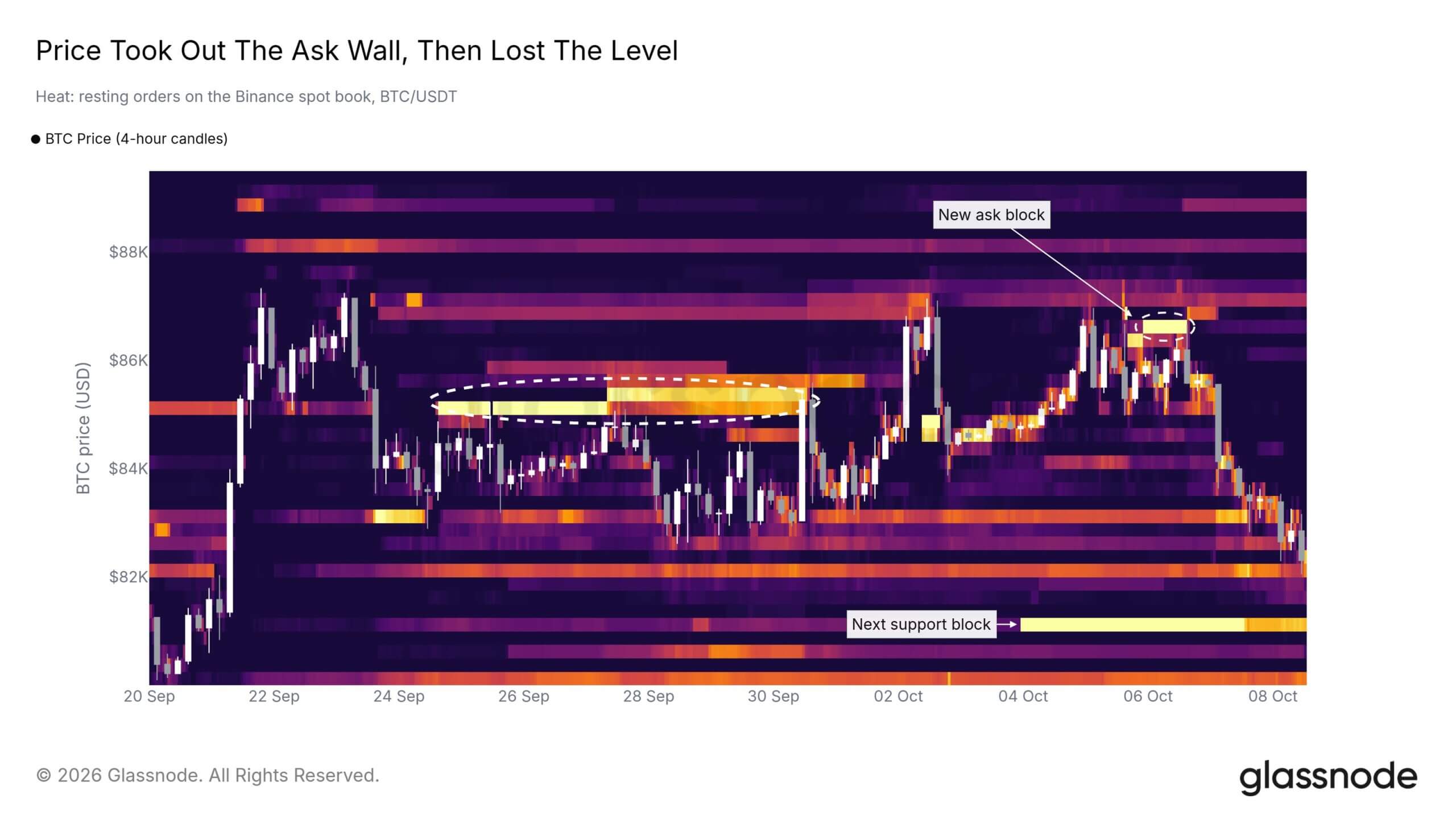
The research firm highlighted this band as a critical support region after Bitcoin failed to break through sell walls resting between $86,500 and $86,750, subsequently losing the support base formed around $85,000.
Still, dense buy orders offer no absolute guarantee of price defense. Bids can be pulled at any time, and persistent selling could easily overwhelm active demand.
Glassnode’s derivatives study mapped out a dense concentration of potential liquidation thresholds spanning $81,700 to $83,300, alongside another notable cluster sitting close to $75,000.
With the recent drop already cutting through a major portion of the near-term band, traders are watching closely to see if the $81,000 demand zone can hold up against ongoing downward pressure.
A confirmed breakdown beneath the $81,000 bid shelf could push Bitcoin down further, potentially drawing focus toward the deeper pockets of liquidations flagged by Glassnode.